Saturday, January 28, 2012

Om... from the Mexican Caribbean

these days see us hanging out on a gorgeous white sand beach near Tulum, Mexico...

For my part, I am doing yoga, writing, reading and finding bliss between the still-lingering jungle, hidden cenote at the tent camp where we are staying and the ocean surf.

Om.....

Seriously.  A view from a short walk away from the tent where we are staying, lulled to sleep each night by the sound of wind in the trees and the ocean surf.


This is a truly awesome area where we are encountering all sorts of wise and spiritually engaged Canadian 'refugees' who seem for the most part to be hiding out from how corporatized and materialistic they see their country becoming... 

I am not quite so ready to permanently leave beautiful Canada but for now, hanging out here will surely do.

We have a sand engineer with us who is creating architectural delights on the beach every day.


The cenote is a sacred deep well of water long revered by the Mayan people.  Here is a sunset shot taken on the secret cenote beside our tent camp.


Before we got to Tulum, we travelled through Lima, Miami (South Beach) and Cancun to get here.  I enjoyed South Beach the most.  It was fun to immerse ourselves in the Art Deco vibe of the place and the interesting classic Hollywood (and gangster) history dating back to the 1930s.  Although expensive it was just fun, especially after many lengthy bumpy bus rides through Bolivia and Peru.

Here is one of the hotels on Ocean Drive in Miami.  I enjoyed doing some artsy photography of these intriguing buildings all with stories to tell.


There is something called 'travel weariness' which can set in with jumping on so many buses and planes and staying in so many different places, and although we are loving and learning so much from our travels, we are also realizing the beauty of staying put and relaxing in a beautiful place for a while, so for now, here we are.....


Om....

Friday, January 13, 2012

in and around Cusco and Machu Picchu, Peru

I am writing from Cusco, Peru where we are staying for several days.  This city is a charming blend of Incan, Quechua and colonial Spanish legacy with a sprinkling of new age healers and incredibly talented artists thrown in for good measure.   Here is one of the streets with the original Incan foundations upon which much of the downtown part of the city was rebuilt by the Spaniards.  It is truly amazing how closely & perfectly these massive stone blocks fit together.


We are hanging out in the funky San Blas part of town which is really very charming with its very (narrow & steep) pedestrian-oriented streets.  Not too many automobiles way up here where we are which makes for a peaceful and restful stay.  We are living in a Peruvian household - they rent out some rooms to tourists here, and I love our room.  Here is a photo taken out the window while sitting on my bed.  A room with a view.  I love it!  For sure I can see why this area attracts so many artistic people.


The bull duo (you can just see them on the roof on the photo above) sits on many roofs throughout Cusco.  Here is a close-up of 2 of these rather endearing characters, purchased at the market for 3 soles ($1).  I am not sure yet exactly what I will do with them back in Canada.... any ideas let me know!  A little good luck would not be a bad thing now, would it?


Of course, a trip to Cusco would not be complete without a (very costly) sidetrip to Machu Picchu.... would it?  Yes, we went!   And here is the proof, our official family photo.


As magical and sacred as ever.

Actually, it was my second trip to Machu Picchu. I was there almost 10 years ago, and interestingly, had a very different experience this time around. 

Whereas last time I was scaling the local mountains as fast as I could - in particular, Huayna Picchu and Putacusi, this time, when we first arrived the whole of Machu Picchu was shrouded in thick rain cloud so much so that we could not see where we were.  So this visit, my focus was on the small and close. . . things like rock, insects, little animals, birds and plants which also make up part of the place. 

I like to think of it this way - that last time I had an experience of the realm of the condor and this time, I perhaps experienced more of the realm of the serpent, the realm of rock and the earth that holds us up.  (Andean cosmology comprises the realm of the condor, puma and serpent).


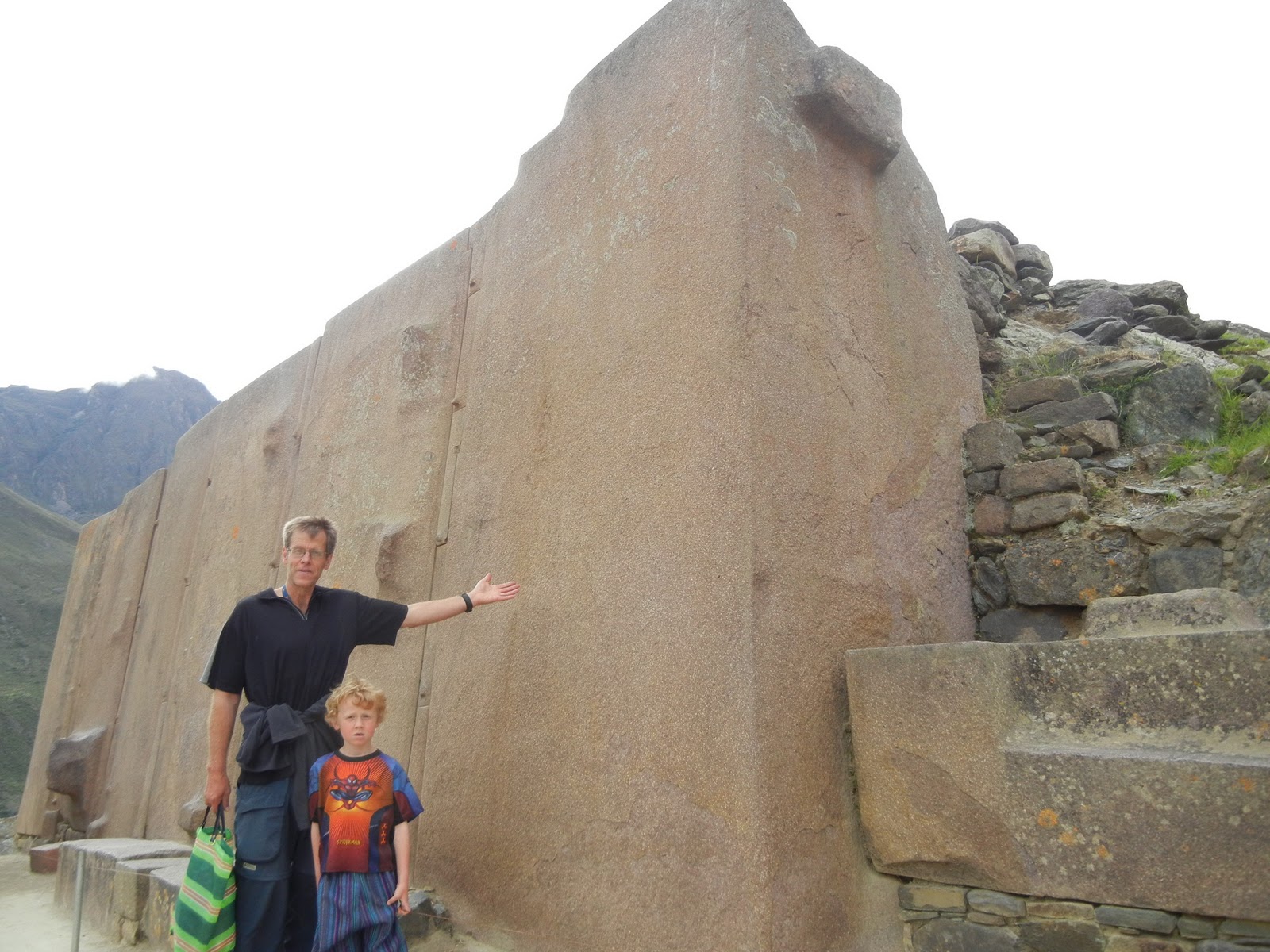
On our way back to Cusco, we stopped off at Ollantaytambo and visited the ruins there, right on the edge of town. 


Steve was particularly interested by the massive and perfectly cut / positioned slab of stone at the Temple of the Sun at these ruins.  How did it get up there onto the mountain and how was it so perfectly positioned without incurring any damage?  Many such mysteries circle around these interesting Incan and pre-Incan ruins scattered through South American.


Ollantaytambo is interesting because people still live in the Inca buildings and use the Inca streets and waterways.


The campesino culture is still strong in this area.
Let's hope it stays that way.

Wednesday, January 4, 2012

Salar de Uyuni, Bolivia, y Feliz Año Nuevo

Well we made it to the Salar de Uyuni in southwestern Bolivia, a place Steve really wanted to see & a place I visited 9 years ago and was happy to visit again. 


One thing about the Salar - the largest salt flat in the world - is that it always changes. Not only did we meet a giant boy during this visit, but also the surface of the salt was covered in water as we headed out toward Isla Incahuasi, the trippy island full of giant cacti (also known as Isla de los Pescadores) so we felt like we were travelling through the sky.


We stayed in a salt hotel - a hotel constructed of salt - and listened to the pounding rain pour down outside as we sat and chatted with other tourists.  In the morning we headed out across the desert to see the various shallow lakes (which sadly are noticeably drying up) where flocks of flamingoes feast.


Laguna Colorada with its pink water reflective of the flamingoes and the volcano in the background is certainly a highlight.


Our third day saw us getting up at 4 am.  First stop was these geysers at 4270 meters.


We dropped some tourists off at the Chilean border, then we headed back to Uyuni with the driver.  On the way back we stopped at Valle de las Rocas where these mystical giants watch the sky and the silence is loaded with mystery.


I think we covered 1000 km in 3 days.  Unfortunately more rain on the way back to town (the rainy season has started and these rains are torrential when they come!).  Here is our driver fixing a broken wheel. . . just a tad muddy! 


Got back to town in time to get the new year´s in Uyuni and got some charms and herbs from a Quechuan woman in the market.  I was told to pour a little alcohol on the ground in honour of Pacha Mama and burn the bundle for good luck in the new year, which I did.


Tomorrow we head back to Peru... where we will spend the rest of our remaining South America time.

Time is flying ...


a kid's guide to Bolivia

1.  Best slide, Uyuni playground


2.  Best ice cream sundaes, Dumbo's Restaurant, La Paz


3.  Best dinosaurs, Cretaceous Park, Sucre


4.  Best chocolate, Para Ti, Sucre


5.  Best bird-watching, Biocentro Guembe Mariposario Resort, Santa Cruz


6.  Best swimming hole, La Cuevas


8.  Best frogs, Sahuiña, Lake Titicaca
                                        (fyi, frog released back into the lake shortly hereafter)

9.  Best place to play with my toys, Salar de Uyuni

Friday, December 23, 2011

Feliz Navidad and revolutionary thoughts from Bolivia

Steve made a new friend - a red howler monkey in Samaipata where we stayed for 10 days. Samaipata is in the foothills of the Andes mountains and as new-age / trendy as small town Bolivia tends to get. Nearby is the ancient (pre-Inca) ruin known as "El Fuerte," it's full significance rather mysterious. The main part of the ruin is a a carved out temple-like area on a hilltop with various creatures, serpent, puma, jaguar for instance, carved into it. Some locals were planning a summer solstice celebration for Dec21 at that location but we had to move on before then.
Before we left Samaipata, we enjoyed hiking around & swimming at nearby waterfalls, "Las Cuevas."
From Samaipata we followed "La Ruta de Che" (the route of Che Guevara). Che was a Cuban revolutionary who came to the rural areas of Bolivia in the 1960s in hopes of starting up a campesino-led revolution in this country. Che was very involved with the Cuban revolution and during his time in Bolivia (and other countries such as the Congo before he got here) he was a marked man by the CIA in the United States as his was a Communist philosophy - and so a rigorous CIA-backed campaign in Bolivia led to Che's final capture & summary execution in a small schoolhouse in La Higuera, a town we visited. After he was killed, his body was then flown to another town Vallegrande and displayed in the laundry room of the local hospital for 2 days so the international media and others could come and it could be verified to the world that Che was dead. Here are the old sinks in the Vallegrande hospital's laundry room where his body was laid. It is still a hospital but as you can see this room has been turned into a veritable shrine to Che's honour with graffiti all over it, some of it addressing very contemporary issues. My favourite quote I think was "no mas Wall St."
Before we carried on further down la ruta de Che, we hired a taxi and went out of town to see a bit of ancient "arte rupestre," interesting figures on vertical rock. I was curious about what these creatures were exactly and what their significance may have been.
It was not at all easy to get to La Higuera, place of Che's last stand and death, but it was well worth the effort. The road to La Higuera was incredibly windy, narrow and mountainous. We were now right in the heart of the Andes and very rugged country. I cannot imagine what Che and his comrades must have endured as they tried to summon support for an armed revolution from the campesinos. They never did gain all that much support. Some people informed us it was mainly because the campesinos were scared of the military and also a bit confused by propaganda being put out by the government and military at the time. La Higuera has also turned into a shrine to Che's enduring revolutionary legacy.
It's a beautiful little town in the mountains, and the campesino culture is strong there. Animals wander through at will... pigs, cows, goats, dogs... the people spend their days up in the mountains working on the land. While there we did an interesting hike into a canyon to see the spot where Che was ultimately captured. A star marks the spot.
After La Higuera we carried on over a really intense road through the mountains to reach Villa Serrano. This road becomes impassable to smaller vehicles during heavy rains and requires quite a few river crossings. There are also many areas where the road simply gets flooded out. Much of the land in this area too is carried away by torrential rains when they come. Intense landscape! Villa Serrano was just gearing up for a traditional Christmas festival which unfortunately we had to miss as we had plans to get to Sucre. The campesinos came in from all directions for this occasion.... many on the backs of large trucks like this one parked in the plaza under the Christmas lights.
And so now we are in Sucre. Here is one Christmas activity this year - a little different than our regular skiing, skating, snowshoeing, tobagganing and sleigh-riding.... Christmas will be different this year.
FELIZ NAVIDAD!

Tuesday, December 6, 2011

jungle adventures in Bolivia

Well we did a major splurge and decided to go on a river boat tour down one of the biggest tributaries of the Amazon River, the Mamore River. It is the largest river of Bolivia and very wild. We headed to Trinidad in the Beni Region and there were met by folks from Fremen Tours who run the boat, the Reina de Enin.


Being on the boat was like being transported back in time to the 1920s or something and was very romantic. What a great way to travel a river. I could not help but think of the larger boats that used to travel the great rivers of northern BC, the Nechako and the Fraser. The food was great and after some roughing it here in Bolivia, it felt pretty decadent on the boat.


We saw monkey and river dolphins - these fresh water dolphins are very curious and came near the boat to check us out. The nights on the boat are full of jungle sounds. The diversity of life is astounding. The Mamore River flows through the Beni region of Bolivia, a low-lying area. During the rainy season - which will commence this month or next - much of the jungle in close proximity to the river - is completely flooded & then only accessed by canoe rather than foot.


The people (many of whom still live very traditional lives near the river and utilize dugout canoes with small engines to transport items) are fairly nomadic and their traditional houses are built up on stilts which serves the dual purpose of keeping critters out & dealing with rising waters during the rainy season.


It was hard to leave the boat and head back into Trinidad to catch the 10 hour night bus back to Santa Cruz. Here we are back on shore with the people & parrots relocating, probably from more rural areas into the larger urban areas (a continuing trend in Bolivia).


We then headed to Buena Vista, a small town on the road between Santa Cruz and Cochabamba. Buena Vista serves as a good launching point for a tour into the tropical side of massive Parque Amboro. To get into the park requires at least 4 river crossings with a couple of them being quite major rivers. No bridges... the vehicles (and horses) simply go right through the water so needless to say, during the rainy season, this road becomes impassable for a period of time (other than by canoe).

We went into the park for 2 days with a guide and stayed in a tent at a very rustic camp spot inside the park. We were actually camping right in the jungle with all sorts of creepy-crawlies crawling all over the outside of the tent and around the outside.

Bug-adverse people may not care for the experience all that much. It seemed like we had the whole place to ourselves -- other than the bugs & other jungle creatures. Here are only a few of the many butterflies we encountered.


This park is home to quite a few swimmable river holes and gorgeous waterfalls. Here is a particularly delightful spot where we enjoyed a marvellous swim - much needed in the hot humid jungle climate.


The trees of the jungle have so much character - here is a bibosi tree with its interesting roots growing all over the place and of course we saw many walking trees, those trees that seem almost to wander around the jungle floor in search of water, with their root system functioning as a kind of set of legs.


The creatures that dwell in the jungle are magical and diverse....


we even encountered one large white flying creature (about the size of a bat) that our guide did not know - maybe a vibora cucu (unfortunately I did not get a picture!)

Then back to Buena Vista where we stayed at a community-run (rustic) ecoalberque, Candeleria. Just down the road was a swimming pool & organic fair trade coffee plantation.... here I am enjoying a Buena Vista cappucino. Yum!


Yesterday we were lucky to get through a massive road blockade between Buena Vista and Santa Cruz. Some mototaxi operators are protesting extra fees they must now pay.... they shut down the entire highway and many people were stranded on the side of the hot highway for hours and hours so we were lucky to get through. But now, for the time-being, we are sort of trapped in the city of Santa Cruz (blockades on several routes out of here) so for now....

we are just hanging out.